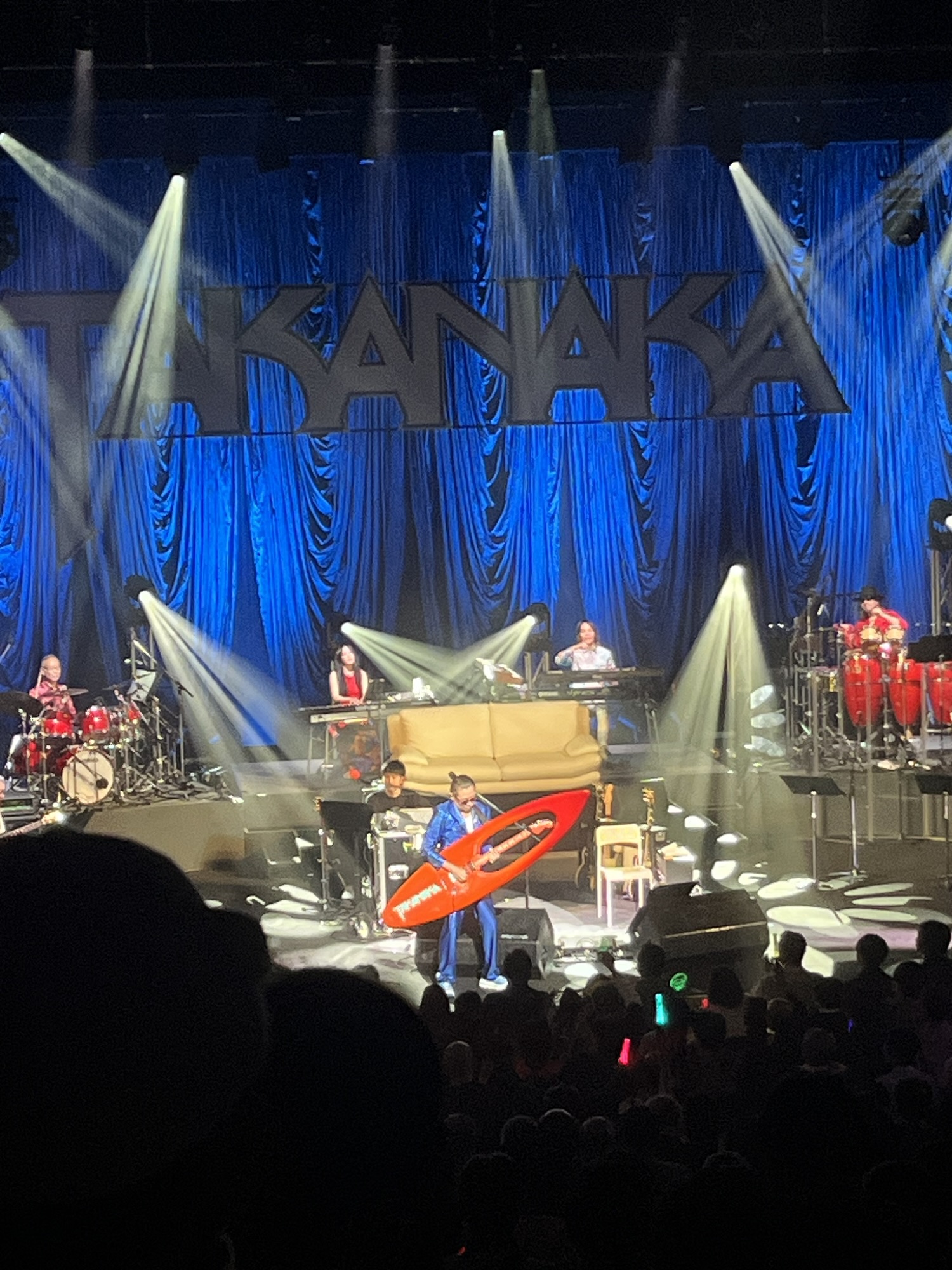
Guys, remember how back in September I mentioned how jazz fusion legend Masayoshi Takanaka was one of the few Japanese musicians I was familiar with? No? That’s okay, it was a long time ago. Maybe you remembered how he played a guitar contained entirely within a surfboard? Anyway, when I found out that he would be playing in Hiroshima, just a brief ferry ride away, I jumped at the chance to buy a ticket. You know who else bought a ticket? My friend Walid from Kochi. Buying concert tickets in Japan is a complicated process involving lotteries, randomly assigned seats, and paying at kiosks in convenience stores. Thought you had your ticket after paying for it at Lawson? Nope, that’s just your receipt – gotta go back to actually get your ticket. Nevertheless, here we are.
The Origins of Jazz Fusion
Let’s talk a bit about jazz fusion. Oh boy, one of my favorite topics. Broadly speaking, jazz fusion arose in the late 1960s when jazz musicians began to incorporate aspects of contemporary pop music into jazz compositions. Jazz in the late 60s was in a crisis, as its cultural dominance had been ceded to rock n’ roll. The two genres up until this point had been mostly separate, despite their shared roots in rhythms and blues. A few artists like Ray Charles had pioneered a new sound by blending R&B, gospel, jazz, country, and more – but they were the exception. Some of this separation was racial – much like the arbitrary division between country and blues, a product of segregation in music and marketing – but it was also stylistic. Jazz felt old and stuffy, music played by older men in suits, scarred by heroin. The death of John Coltrane in 1967 at the age of 40 felt like an inflection point. Rock n’ roll was by and for young people, flamboyantly dressed and opening their minds with psychedelic drugs. Whether it was a conscious choice to “save jazz” by adapting it to better align with mainstream tastes or a natural evolution, jazz began to sound more like rock and R&B music toward the end of the 1960s.


1968 feels like the year to start with. In Miles Davis’s autobiography, he recounted that in this year he had been listening to Jimi Hendrix, James Brown, and Sly and the Family Stone. These artists, like Ray Charles before them, fused elements of blues, rock, soul, funk, and countless other genres together to create an electrifying new sound. Also in 1968, the composer David Axelrod (not to be confused with the Obama staffer of the same name) released the album Songs of Innocence, which in addition to becoming prized sample material for hip-hop producers (most notably the song “Holy Thursday” was sampled by Swizz Beatz for Lil Wayne’s “Dr. Carter” from his masterpiece Tha Carter III), spawned a review that allegedly coined the phrase “jazz fusion.” That year Miles Davis recorded Filles de Kilimanjaro, in which you can hear the transition from the post-bop sound – which arose in 1964 – to the electric fusion that the future held in store. The personnel for this album featured Davis on the trumpet, Wayne Shorter on tenor saxophone, Herbie Hancock and Chick Corea on electric piano, Ron Carter and David Holland on bass, and Tony Williams on drums. Davis’s subsequent album – In a Silent Way (1969) – is considered his first true fusion album, consisting of two lengthy, improvised suites with a sparse, atmospheric sound. The album included two new additions to the band who would become giants in the jazz fusion scene – Joe Zawinul on keyboard and John McLaughlin on guitar. It is impossible to overstate the influence of following album, Bitches Brew (1970), on the evolution of music.


Back when I had my radio show at American University, my friend and fellow WVAU disk jockey Henry (blog readers may recall him from my Korea and Thailand adventures) and I collaborated on a Japanese jazz fusion program, and during our broadcast Henry observed that I mentioned Bitches Brew so often that I should put a dollar in a jar for every time I did. Bitches Brew saw the eschewing of the jazz swing beat in favor of a rock n’ roll backbeat and bass guitar grooves. Davis plugged his trumpet into electric pedals and soundboards to create an entirely new sound. This remarkable innovation brought Davis commercial success – the record sold 400,000 copies, four times his usual average – but scorn from jazz critics. Much like how Bob Dylan was labeled “Judas” for evolving from acoustic folk to electric rock n’ roll, Davis was branded a sell-out for innovating his sound. Jazz critic Stanley Crouch was practically foaming at the mouth as he derided Davis as “the most brilliant sellout in the history of jazz” whose recent work was “an abject surrender to popular trends” that embraced “youth culture vulgarity.” To Crouch, In a Silent Way was “long, maudlin … little more than droning wallpaper music” while Bitches Brew was nothing but “static beats and clutter.” Davis’s further evolution was “progressively trendy and dismal, as did his attire; at one point in the early 1970s, with his wraparound dark glasses and his puffed shoulders, the erstwhile master of cool looked like an extra from a science fiction B-movie” and the music constituted “a sound so decadent that it can no longer disguise the shrivelling of its maker’s soul.”

Unperturbed by critics, Davis forged on. Subsequent studio albums included Jack Johnson (1971) and On the Corner (1972) and saw Davis continue his musical exploration. The venues for his live albums at this time can tell us a lot about how his audience was evolving. He played the Fillmores West (San Francisco) and East (New York) in 1970 – spaces usually populated by a younger, whiter crowd who usually listened to bands associated with the psychedelic rock sound of promoter Bill Graham (who also ran the venues): the Grateful Dead, Jefferson Airplane, and Janis Joplin’s Big Brother and the Holding Company. On April 10, 1970, Davis opened for the Grateful Dead at the Fillmore West, documented in the live album Black Beauty.

Members of Davis’s band branched out on their own albums. Herbie Hancock, my personal favorite, released the seminal funk masterpiece Head Hunters (1973) with his band the Headhunters, and his sound incorporated aspects of funk, disco, and early hip hop as the decade progressed. Fellow pianist Chick Corea showed some Brazilian influences on his 1972 album Return to Forever (apparently Corea’s conversion to Scientology resulted in a more accessible musical style to better communicate with his audience). Zawinul and Shorter started the band Weather Report, whose 1977 album Heavy Weather is one of my favorites. Williams teamed up with McLaughlin to form the Tony Williams Lifetime and record the album Emergency! shortly before Bitches Brew. McLaughlin had experience playing with rock legends like Eric Clapton and Mick Jagger, and formed his own group, the Mahavishnu Orchestra. The band’s name illustrates how rock and jazz music was captivated by Indian music, culture, and religion around this time (Alice Coltrane, an excellent musician in her own right, became devoted to Hinduism after her husband’s death).
![Herbie Hancock / Head HUNTERS[輸入盤]](https://m.media-amazon.com/images/I/81KRhLp0JGL._UF894,1000_QL80_.jpg)

![WEATHER REPORT / Heavy WEATHER[輸入盤]](https://m.media-amazon.com/images/I/81VCdBI5+bL._UF894,1000_QL80_.jpg)

On the other side of the equation, rock acts were becoming more interested in jazz. Artists like Frank Zappa and Santana were heavily influenced by jazz sounds, and Steely Dan arguably packaged jazz chords into a rock format to create a pop-friendly take on jazz fusion. (The origins of yacht-rock – a much-maligned but influential and technically proficient offstream of jazz fusion – can be traced back to Steely Dan’s wide-ranging and revolving door of session musicians, as outlined in HBO’s recent Yacht Rock Dockumentary.) Carlos Santana collaborated with the Mahavishnu Orchestra, John McLaughlin, and Alice Coltrane (he even got into Hinduism, taking the name Devadip), and played with Hancock, Shorter, Carter, and Williams on the album The Swing of Delight (1980).

All of this was really to set up the contrast between American and Japanese jazz fusion, but I got a little carried away. I didn’t even get into smooth jazz or prog rock. Before we get into Japanese jazz fusion (or JJ fusion, for short), my American recommendations for your listening pleasure.
Artists/Albums mentioned:
- Miles Davis
- In a Silent Way (1969)
- Bitches Brew (1970)
- Live-Evil (1971)
- On the Corner (1972)
- Black Beauty: Miles Davis at Fillmore West (1973)
- Agharta (Live in Osaka) (1975)
- Dark Magus: Live At Carnegie Hall (1977)
- Herbie Hancock
- Head Hunters (1973)
- Sextant (1973)
- Thrust (1974)
- Flood (Live in Tokyo – 1975)
- Secrets (1976)
- Mr. Hands (1980)
- Chick Corea
- Return to Forever (1972)
- Weather Report (Wayne Shorter, Joe Zawinul, etc)
- Mysterious Traveller (1974)
- Heavy Weather (1977)
- The Tony Williams Lifetime (Tony Williams, John McLaughlin)
- Emergency! (1969)
- Carolos Santana
- Love Devotion Surrender (with John McLaughlin, Mahavishnu Orchestra) (1973)
- Lotus (Live in Osaka) (1974)
- The Swing of Delight (with Herbie Hancock, Wayne Shorter, Ron Carter, and Tony Williams) (1980)
- Steely Dan
- Can’t Buy A Thrill (1972)
- Aja (1977)
- Gaucho (1980)
- Frank Zappa
- Hot Rats (1969)
- Apostrophe(‘) (1974)
- Philly ’76 (1976)
- Joe’s Garage Acts I, II & III (1979)
- Sheik Yerbouti (1979)
- Sleep Dirt (1979)
Artists/Albums Not Mentioned
- Red Clay (1970): Freddie Hubbard
- Live At Club Mozambique (1970): Dr. Lonnie Smith
- Journey in Satchidananda (1971): Alice Coltrane, Pharaoh Sanders
- Two Headed Freap (1972): Ronnie Foster
- Live at The Lighthouse (1972): Grant Green
- The 2nd Crusade (1973): The Crusaders
- Power Of Soul: Idris Muhammad (1974)
- Blackbyrd (1974): Donald Byrd
- Canyon Lady (1975): Joe Henderson
- Gears (1975): Johnny “Hammond” Smith
- Breezin’ (1976): George Benson
- Pressure Sensitive (1975): Ronnies Laws
- Lanquidity (1978): Sun Ra

Across the Pacific
Jazz has a long history in Japan. Apparently jazz made its way to Japan in the 1910s through luxury ocean liners traveling between the West Coast of the United States, the Philippines (an American colony at the time), and Japan. The beginning of the popular recorded music industry soon followed, and by the 1920s the Japanese equivalent of flappers were dancing to jazz in music halls. In addition to dancehalls, kissaten (tearoom/coffee shop/cafe) began to flourish as a quiet space for intellectuals where jazz amplified the background ambiance. During World War II, listening to American jazz was prohibited in Japan and the Japanese people were ordered to turn in their LPs. Many did not, however. Following the war jazz experienced a massive resurgence, especially because American troops stationed there wanted to hear it.


American soldiers dancing with Japanese women to jazz (1945), and a scene mirroring this in High and Low (1963)
The Japanese jazz scene really took off after the war. The bebop pianist Toshiko Akiyoshi was discovered by the legendary Oscar Peterson, and she ended up studying at Berklee College of Music and achieving global success. American (non-military) acts like Art Blakey and the Jazz Messengers (an incredible lineup with Lee Morgan, Wayne Shorter, and others accompanying Blakey (who was married to a Japanese woman and had Japanese children)) began to tour Japan in the 1960s. Dave Brubeck and his Quartet recorded an album called Jazz Impressions of Japan, inspired by their 1964 tour. Also in the 1960s, Japanese jazz musicians, responding to frequent criticisms that they were derivative and simply imitating American musicians and styles (a phenomenon compounded by the Japanese jazz critics themselves by constantly comparing Japanese artists to American ones), began to forge their own path. Japanese artists incorporated elements of traditional Japanese music – Hideo Shiraki recorded with koto players, Minoru Muraoka played the shakuhachi, and Akiyoshi utilized the tsuzumi as well as native Japanese melodies.


My friend John Criddle and I try out the shakuhachi
Other Japanese artists found international fame – a Japanese band, the Sharps and Flats Big Band – played arrangements of Japanese folk songs at the Newport Jazz Festival in 1967.

Aided by Japan’s booming economy, Japanese jazz began to adapt to changing sounds in popular music around the same time as this phenomenon was originating across the Pacific. Sometimes Japanese and American musicians collaborated on records. Bossa nova saxophonist Sadao Watanabe, a member of Akiyoshi’s band who followed her to Berklee, recorded Round Trip in 1970 with Chick Corea, Miroslav Vitous (bassist and founding member of Weather Report), and Jack DeJohnette (drummer who played with basically every name I’ve mentioned plus more). Bassist Teruo Nakamura (not to be confused with the Japanese soldier of the same name who fought until 1974) played with drummer Alphonse Mouzon (who also played with Weather Report, Hancock, and many more) on Unicorn (1973). Guitarist Ryo Kawasaki played with Gil Evans, Elvin Jones, and many other American legends (he was also a member of Tarika Blue, whose song “Dreamflower” was sampled by J Dilla for Erykah Badu’s “Didn’t Cha Know”). I could go on and on.


Japanese Artists/Albums:
- Sakura Sakura (1965): Hideo Shiraki Quintet + 3 Koto Girls
- Sharps & Flats in Newport (1967): Nobuo Hara and His Sharps & Flats
- Round Trip (1970): Sadao Watanabe
- Bamboo (1970): Minoru Muraoka
- First (1970): Kohsuke Mine
- Unicorn (1973): Teruo Nakamura
- Kogun (1974): Toshiko Akiyoshi-Lew Tabackin Big Band
- Jiro Inagaki and His Soul Media
- Head Rock (1970)
- Funky Stuff (1975)
- Our Time (1975): Kyoshi Sugimoto
- Scenery (1976): Ryo Fukui
- Cat (1976): Hiroshi Suzuki
- Masayoshi Takanaka
- SEYCHELLES (1976)
- BRASILIAN SKIES (1978)
- Tarika Blue (1976): Tarika Blue
- Butterfly (1979): Kimiko Kasai and Herbie Hancock
- CASIOPEA:
- CASIOPEA (1979)
- MINT JAMS (Live) (1982)
BONUS: Americans In/Inspired By Japan
- Jazz Impressions of Japan (1964): The Dave Brubeck Quartet
- First Flight to Tokyo: The Lost 1961 Recordings (2021): Art Blakey and the Jazz Messengers

Much to my chagrin, many of these are not on Spotify. Head on over to YouTube, where I suspect many people my age have discovered the vibrant Japanese jazz scene. Is that how I came across Masayoshi Takanaka? It might have been the wise word of my friend Ben Burk back in high school.
But my first introduction to Japanese jazz fusion came at a much younger age, through an unlikely source: Mario Kart Wii. The soundtrack of the only video game I really ever played religiously is absolutely jazz fusion – albeit packaged into a shorter, simpler format. The composer for Nintendo who has done all their music – Koji Kondo – has cited Herbie Hancock, Chick Corea, and Casiopea as influences. The origins of this go back to the beginning of Japanese jazz fusion itself. Albums from as early as 1969 featured cover art of race cars, or even incorporated recordings of the cars into the music itself. I guess it’s something about the slick and energetic sound that made people think of driving really fast? CASIOPEA’s debut self-titled album (1979) features race cars on the front cover and the band members dressed in racing suits on the back. This association was further cemented when Fuji TV chose a jazz fusion song – “Truth” by T-Square – to intro their coverage of Formula 1 Racing from 1987 to 2006. One characteristic of the Mario Kart soundtracks is that when you are racing, the speed of the music increases with every lap completed. You can hear this reflected in CASIOPEA’s music, for instance in their song “Space Road.”


This bond between car racing and jazz fusion has even spread outside of Japan – Top Gear, the wildly popular British TV series has “Jessica” by The Allman Brothers Band as their theme song (if you don’t think the Allman Brothers dip their toes into jazz rock, you can fight me in the comments). I’m just a big fan of fusion in general – jazz, culinary, and otherwise.
Okay, enough intro. Unable to secure lodging for Saturday night, I booked a capsule hotel for Sunday and Monday nights for about $50. Friday night was spent at the local indie Cinema Lunatic – which I’ve already frequented half a dozen times – for their screening of old silent movies accompanied by live instrumentation. Satuday night I chilled out, made a big vat of carbonara, and Sunday I was on my way.

You may recall the route from Iyo to Hiroshima. Take the train all the way north to Takamatsu, quick jaunt on the shuttle bus to the Matsuyama Tourist Port, hop on the ferry to Hiroshima Port, and take the streetcar into the city. I dumped my stuff at my capsule hotel around 2:30. Walid and his friends were on the island of Miyajima, and after he warned me that it was mobbed with tourists, I decided to go in a different direction (I had visited Miyajima way back in the day, anyway).


Instead I headed for the Hiroshima City Museum of Contemporary Art, located in a mountainous park in the eastern part of the city. I mentioned in my last Hiroshima blog about how overwhelming the many tourists were, so the quiet sanctuary of the museum was a relief.


This was a crazy sculpture made out of pig skin that I was invited to crawl inside
At the end of one of the exhibits, much to my surprise, was this.


This is Altar Piece (1990), which Keith Haring finished just weeks before his death. It has images of martyrdom in Haring’s typical hieroglyphical style, and was donated by Yoko Ono. Apparently there are nine different versions throughout the world, with a permanent one at the Cathedral Church of St. John the Divine in New York City, where Haring’s memorial was held.


There was a room where a bright flash went off and your pose at the time of the flash would be seared into the ground and walls. I also scored a sweet poster from the gift shop of another cool interactive exhibition that I unfortunately did not get to spend much time in because the museum closed.


After the museum I walked back into the center of town. Hiroshima is famous for oysters, and I was determined to have some for dinner. I’ve been an oyster aficionado ever since I took down some eighteen oysters as a child at Pelican Brewing in Pacific City, OR.


Oysters, three ways. First we had them breaded and fried. If I was to do a deep-fried food pantheon, oysters would be in the upper echelon from a texture standpoint. Second, they were grilled and served with a squeeze of lemon. When you have such high quality oysters, they’re best served as simply as possible. Lastly, they were pan-fried and served with ponzu (a soy and yuzu-based dipping sauce), which the breading was too heavy and sauce too salty for my taste. Much to my surprise, they didn’t serve them raw on the half-shell despite Japan’s affinity for other raw foods (fish, egg, horse, etc).


This was merely the first leg of my dinner, as I met up with one of Walid’s Kochi friends, Jack, for some okonomiyaki. Jack is from Westchester, NY, and we have many common interests from music to TV/movies to basketball.

We then embarked on some bar hopping. First we tried Bar Baobab, a tropical-themed establishment on the 5th floor of an unassuming building. After a few gin and tonics, we floated over to a more lively establishment to meet up with Walid and the rest of his friends.


Here we are at Stevie’s WunderBar – a 70s R&B-themed bar tucked away in a quiet back alley. This is a listening bar, spaces that are prioritized to the listening of music on high-quality audio equipment. These places originated here in Japan, but have spread to Korea (as longtime ZevEatsIt reader may recall) and are starting to crop up in the States as well. There’s a piano built into the bar, which comes in real handy when you’re jamming out to Motown classics. We tell the bartender that we’re here to see Takanaka, and he spins an obligatory track. Walid, with his friends Steven from North Carolina and Kaylee from Long Island in tow, arrive. My only objection (besides the soda in my Cuba Libre being flat) is that the place is too small to have a dancefloor.


The five of us migrate to another location that promises a pool table. Having left behind expert DJing, we encounter the opposite end of the spectrum: DJing off of YouTube.

This place had a really bizarre scene: mostly Nepali staff and clientele, with a few other foreigners and Japanese mixed in (including one Japanese guy who was dressed like J-Roc from Trailer Park Boys). The music is a mix of 2010s pop standards, which adds to the surrealness. You thought you had heard “Young, Wild & Free” by Snoop Dogg and Wiz Khalifa so many times that it had become background music, like elevator muzak – there’s nothing like doing the can-can with Japanese dudes blasting indoor cigs to revitalize it. We stagger out at 3 AM sometime after I get them to play “Blow the Whistle.”
I wake up at 11 AM with that special headache + congestion combination that can only be incurred by a night of hard-drinking. Coincidentally, I find a kissaten (retro coffee shop) near me with a special name.

For those who can’t read katakana, this is “Oregon Coffee House.” Given its proximity to the heart of Hiroshima and the high density of tourists, I half-expect to be sipping Stumptown Coffee or a hazy IPA surrounded by Portland memorabilia, but instead it’s a totally ordinary kissa run by an ancient oba-chan (grandmother) who pours me a totally ordinary cup of coffee as I squeezed into a table too low for me. Perhaps I should have inquired why it was called Oregon Coffee House given the lack of anything recognizably Oregon-esque, but it slipped my mind. I decided to procure a universal salve after a long night of drinking.

I should have gotten a picture of the colorful exterior of “Cafe Latino,” where I tried to order feijoada and a Guarana and ended up pivoting to a carne asada burrito and horchata when I was told they didn’t have feijoada today. Jack came and joined me, and we went and checked out the Shukkeien Garden after breakfast/lunch.


The garden as seen through my digital camera
For some reason, the concert started at four in the afternoon. Have you ever heard of this for a standalone artist? Doors at 3:30 – really strange, but nonetheless we headed over to the venue. While I wasn’t expecting a Grateful Dead Shakedown Street lot/tailgate situation, there was very little fanfare in the venue. I wasn’t even sure we were in the right place until I saw the scores of other young foreigners bounding up the stairs. Aside from a modest merch table (reasonable prices but bland designs), you could have told me I was here to see a production of Fiddler on the Roof, and I would have said it seemed appropriate. The venue was not right for a rock show, with narrow aisles and nowhere in the front to stand/dance. Nevertheless the crowd was so excited to see him that most people stood at their seats throughout anyways. I snuck a few pictures and videos (which you’re not supposed to do, as I was chastised).
Takanaka is 72 years old, and you sometimes go see an older artist only to find that they’ve lost a step or two (as was my experience with Dead & Company at New Orleans Jazz Fest a few years ago). But Takanaka is as sharp as ever, and put on the best display of guitar-playing that I have had the good fortune to see live. He sashayed up and down in the stage in a bright-blue suit and absolutely shredded. I don’t really know any of the song names (as is sometimes the case with instrumental artists) though I recognized some, but it was an amazing show. And for the encore, he brought out the legendary surfboard guitar.

Buoyed by his international popularity, Takanaka is headed to a few cities in the States, and if he’s in your city I would encourage you to go see him. The crowd was interesting, probably 75% middle-aged to elderly Japanese people and 25% young foreigners. The show was so good and the crowd was so into it that it overcame the wrong venue choice – Takanaka’s music sounds like pure joy, and it’s really something that should be heard outside on a warm sunny day (preferably on the beach in Rio).

Afterwards we grabbed dinner, and I retired early. I got up early the next morning, hustled to get the 9:05 ferry back to Matsuyama, and made it back to school for afternoon classes.

Aaaand that was my Hiroshima trip! It’s almost time to head to Osaka to see Herbie Hancock, and I’m not sure what I’ll write about since I used up most of my jazz fusion material here. I guess we’ll see.
Here’s the Google Form comment section just in case: https://docs.google.com/forms/d/e/1FAIpQLSfH3_ssKLtWRHGhC6m7InL7HvqTP48TUJHzRouhXike2erWzA/viewform?usp=header


Leave a Reply to BenCancel reply