Folks who know me might think I’m a snob about some things. And they would be right. I don’t mind suffering fools (in many instances I am a fool), but there are some things I put my foot down about. These can range from dining options to the choice of music in the car, but one of the many things I have high standards about is bagels. This is partially a Jewish thing – as a person of Judaism myself, I feel the integral need to defend the sanctity of bagels. While I can’t speak to when bagels became mainstream (surely it was long before I was born), the reality is that you can now get a bagel pretty much anywhere in the world. Or at least a piece of bread that calls itself a bagel. Many of these are no doubt the infamous “roll with a hole,” but what truly defines a bagel? Who gets to decide what constitutes a bagel (besides me)? Should we have a grand council of bagel experts, and should I be on it? Sound off in the comments below.
In my expert opinion, it is not hard to find a bagel, but it is difficult to find a good bagel. You can walk into your nearby grocery store and grab something that calls itself a bagel. But to get a truly good bagel is no easy feat, unless you live on the East Coast of the United States. Even in Portland, a food mecca unto itself, it’s not easy to find a good bagel – I recently discovered Henry Higgins, which makes a solid bagel. Every time I would come home from college or my DC-based grandparents would come to visit, a dozen Bethesda Bagels, sliced and in Ziplocks, would come along as well. In my experience, the higher the Jewish population of a city, the better the bagel. One can observe this phenomenon by visiting your local Costco. At Costco in Washington DC, you can buy a gallon of whitefish salad (one of my favorite bagel condiments), but Portland Costcos carried this for like a week before it disappeared forever. I guess there weren’t enough people buying it. But another metric you can use to judge a good bagel is off the schmears they have for sale; if the bagel shop has whitefish – or better yet the nasty Old World shit that we ate in the shtetl like chopped liver and pickled herring – that’s a good sign.
Bagels are here in Asia too. Longtime readers will recall my Singapore bagel experience. When I was in Osaka this weekend, I considered checking out a bagel spot, but then I had my train station debacle and never made it back into the city. I’ve had a bagel place in Matsuyama on my radar for a while (perhaps the only one in town), and today I finally went to check it out. I don’t know how many Jews live in Matsuyama, but it’s definitely less than in Osaka (Shana Tova by the way). Google Maps reviews said to get there early and be prepared to wait in line, but I rolled in at the crack of 1 pm.
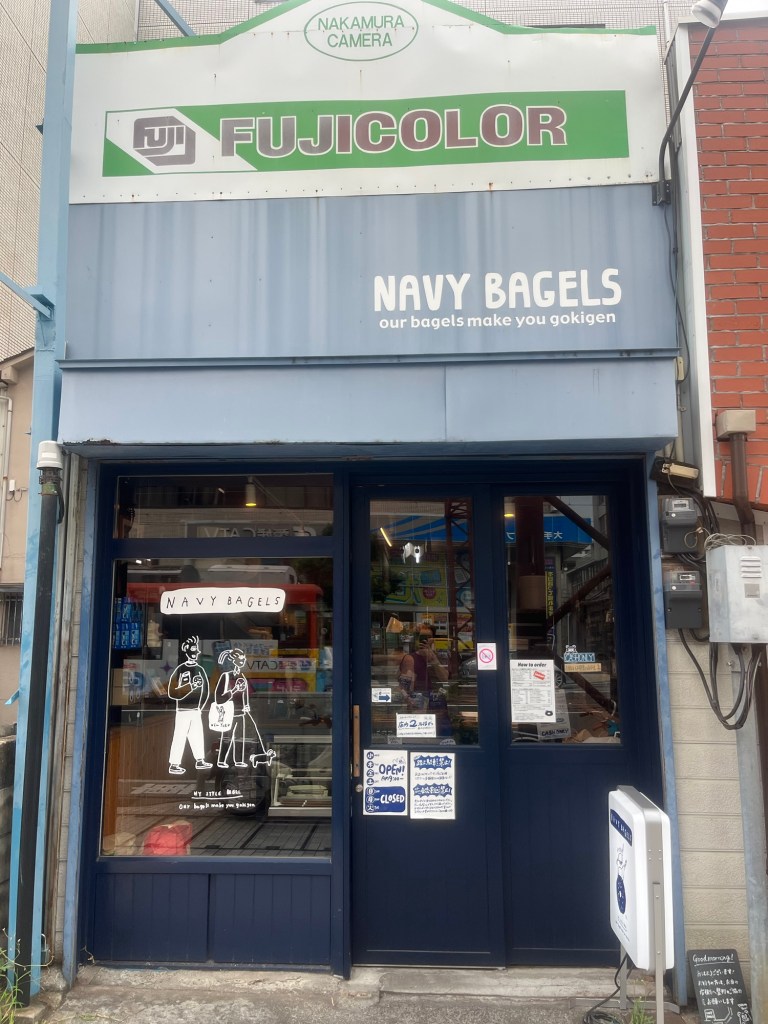
Japan has a lot of these tiny shops, a product of zoning and lower costs, which is awesome because you have these small businesses that surely would not make enough money to hack it in the States. Not only is there no dining in, but only two customers at a time can even be in the shop.
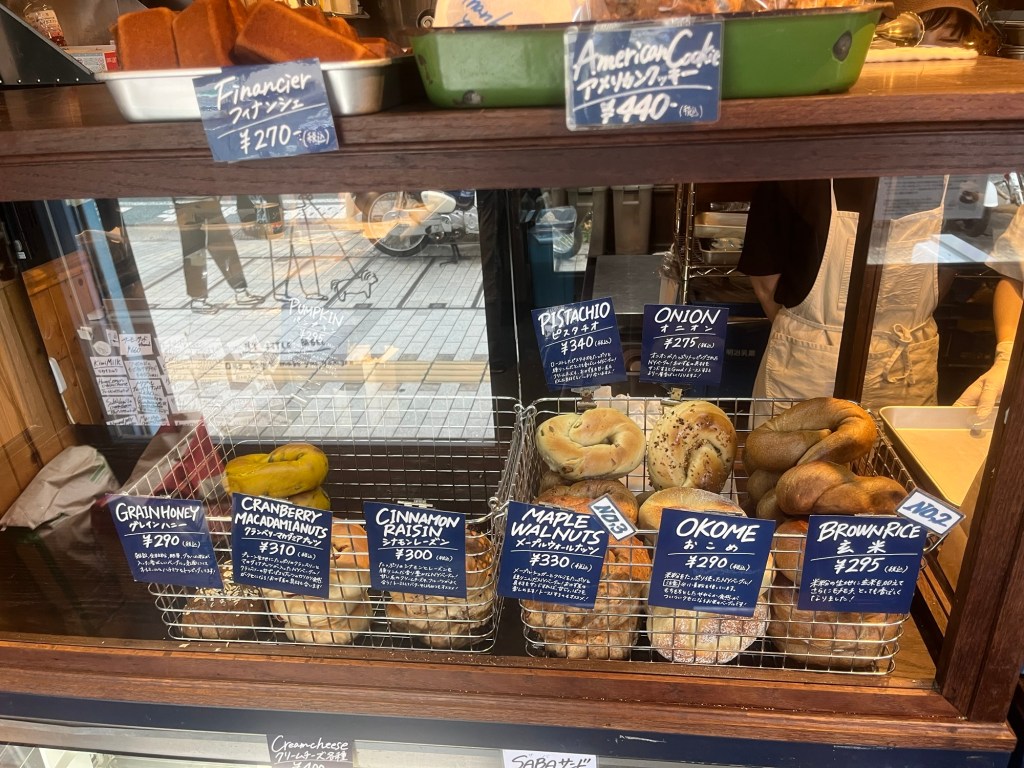
Here’s a look behind the counter. I think by the time I arrived, a lot of their flavors were sold out. There are some sweet varieties (which I’m not a fan of from an ethical standpoint, even if they are tasty), as well as some uniquely Japanese flavors like brown rice and okome (uncooked rice). They also have different cream cheese flavors, which I think are overrated. I’ll take plain or chive, but while something like sun-dried tomato cream cheese sounds delicious, I ultimately find it an unnecessary distraction. Strawberry cream cheese would be good on a pastry or something, but keep it far away from my bagel. In case you haven’t gathered yet, I’m a strict traditionalist when it comes to bagels. At home I get poppy seed, sesame seed, or everything. After a quick peruse of the menu, I went with an onion bagel, smoked salmon with the works for my topping.
Right now, according to the cashier, bagels are trendy in Japan. However, in many places, bagels are being adapted to the Japanese palate. Some Japanese bagels even have a mochi-like texture (apparently). But Navy Bagels seeks to deliver an authentic New York-style bagel. They cite Ess-a-Bagel, which I had never heard of, as an influence. I wonder if these people at Navy Bagels have ever heard of Russ and Daughters, or a bialy.
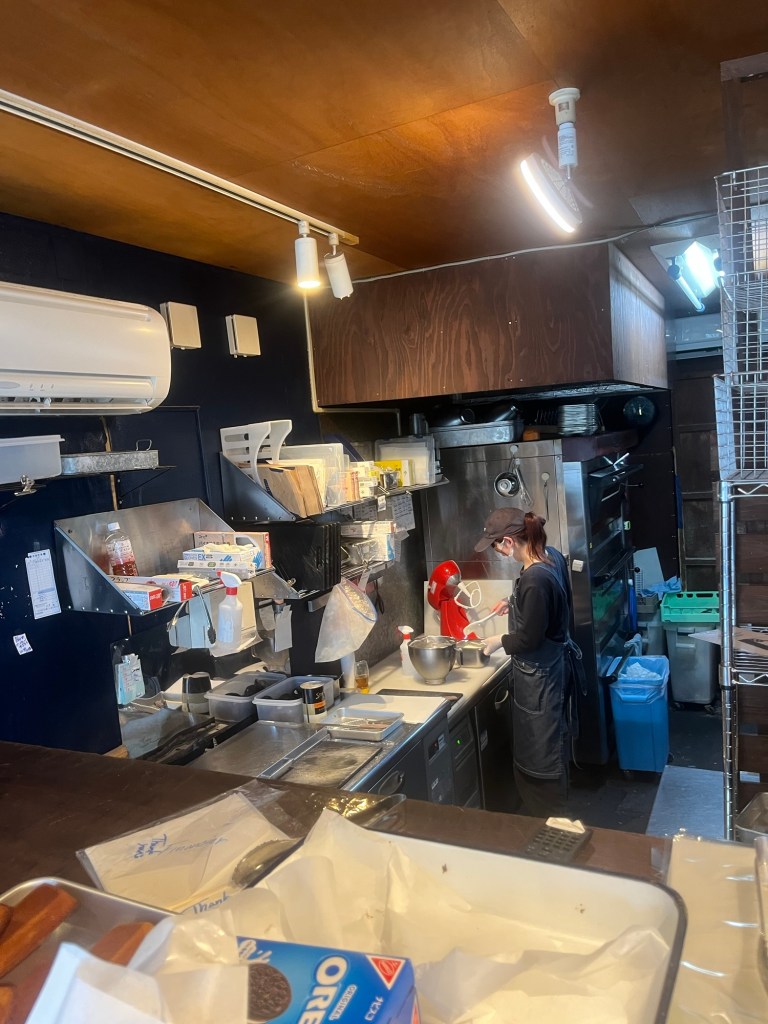
The tiny interior. Yes, you can see Oreos in this picture. Yes, they have Oreo bagels. Yes, I remained civil.
Alright, here’s the grand reveal. My smoked salmon onion bagel also came with the classic cream cheese, tomato, red onion, and caper, as well as lettuce for some reason.
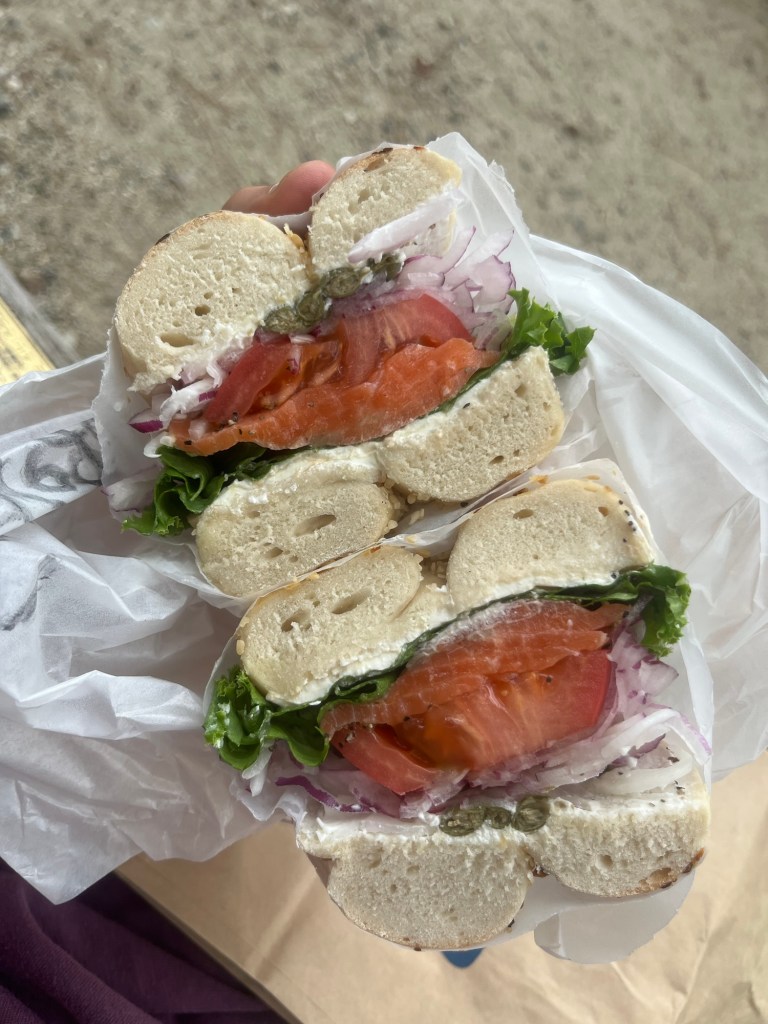
How was the bagel? It was solid. It about met my expectations. While my ideal bagel is crispy on the outside and fluffy on the inside, this bagel, like many bagels, was chewy all the way through. While they nailed the toppings (except for the lettuce), the tomato was way too thick (I ain’t order no fuckin tomatonator). In my Asian bagel rankings, this slots into the #2 spot behind Two Men Bagel House in Singapore. But it certainly scratched my itch for a bagel, and I will be coming back. Would Navy Bagels hire me as their bagel consigliere? While I’ve never made a bagel, I am a fully Bar Mitzvahed Jewish person who has eaten many bagels in his life. Maybe we could have a Tampopo situation where I teach them how to make the perfect bagel and then ride off into the sunset… Now I just have to find a Shabbat dinner in Matsuyama.
To bring this full circle, let’s connect bagels and Japanese cuisine. In an iconic YouTube video (which to my dismay has been lost to time), sports personality Adam Lefkoe took then-Bears running back Tarik Cohen to a Jewish deli (Cohen, despite his name, not of Jewish descent). Tarik, upon seeing a bagel gussied up with the classic lox and cream cheese, thought it was sushi.


Enjoy these stills of Tarik Cohen’s Jewish education, and imagine him trying out some Yiddish slang (for reference, he’s from a town of 300 people in North Carolina).
Totally reasonable for Tarik to see a bagel with lox and cream cheese to think it was sushi. A salmon and cream cheese roll is commonplace at American sushi restaurants – according to Google it’s called a Philadelphia roll because of the cream cheese, but it should obviously be called a Jewish roll. Regardless of what you call it, we know that cream cheese and fish is a good combination.
I think there is a possibility for a Jewish-Japanese fusion bagel spot. Jewish-Japanese cuisine already exists at Shalom Japan in Williamsburg (of course), I haven’t been there for matzah ball ramen yet, but I think some of the fishy flavors of Ashkenazi Jewish cuisine that I don’t especially care for – like herring – would be a hit in Japan. At the bagel shop I saw something on the menu with saba, or mackerel, a fishy, oily fish. On my most recent pilgrimage to Russ and Daughters, I had wasabi-infused tobiko on my smoked trout bagel. Couldn’t you make a seaweed bagel with soy sauce-infused cream cheese and maguro? If Japanese people like natto, would they eat gefilte fish?
Though I may be the only Jew in Ehime Prefecture, I am determined to celebrate Hanukkah when it comes time. Not only would I like to educate my students about the holiday, I also want to make latkes for my new friends and show them how we get down… wait what if you made an okonomi-latke with okonomiyaki sauce, sour cream, and salmon?


 Eat It
Leave a reply to kellyw100 Cancel reply