
Hello!
It’s been quite a while, hasn’t it. Sorry about that. I’ll say that I’ve been busy, which is partially true. But I’ve also been a little bit lazy. When you have no summer homework and you can’t remember the last time you woke up before 10 AM, it can be hard to gather the motivation to do much of anything. But here I am, for the first time in several months. And I have some personal news to share.

In the fall, I will be attending American University in Washington, DC, where I plan to study political science and write more about food. For example, there are many dim sum spots that I must explore. But for now, let’s stay a little closer to home with a jaunt to Beaverton for the best tacos I have ever had.Many times, a restaurant’s ambiance can be an indicator of how authentic and delicious the food will be. For example, if your dim sum restaurant isn’t staffed by Chinese ladies who aggressively push dish after dish on you from their cart, you’re probably in the wrong place. The same logic can be applied to this taco joint. This isn’t a bougie Portland establishment where tacos are $5 each. This is a taco truck parked in the lot of a convenience store on a busy street corner.
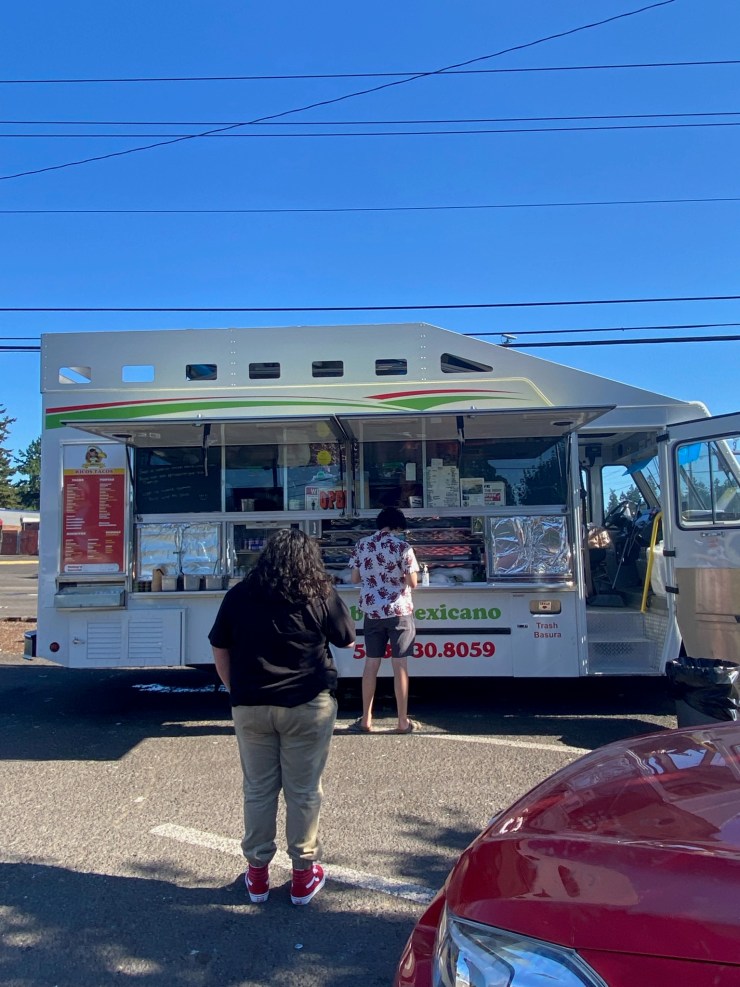
This is La Morenita Ricos Tacos. As per the menu, which is written on a dry-erase board mostly in Spanish, tacos are $2 a pop, or $2.50 for specialty fillings like tripa (tripe), cabeza (head) or lengua (tongue).
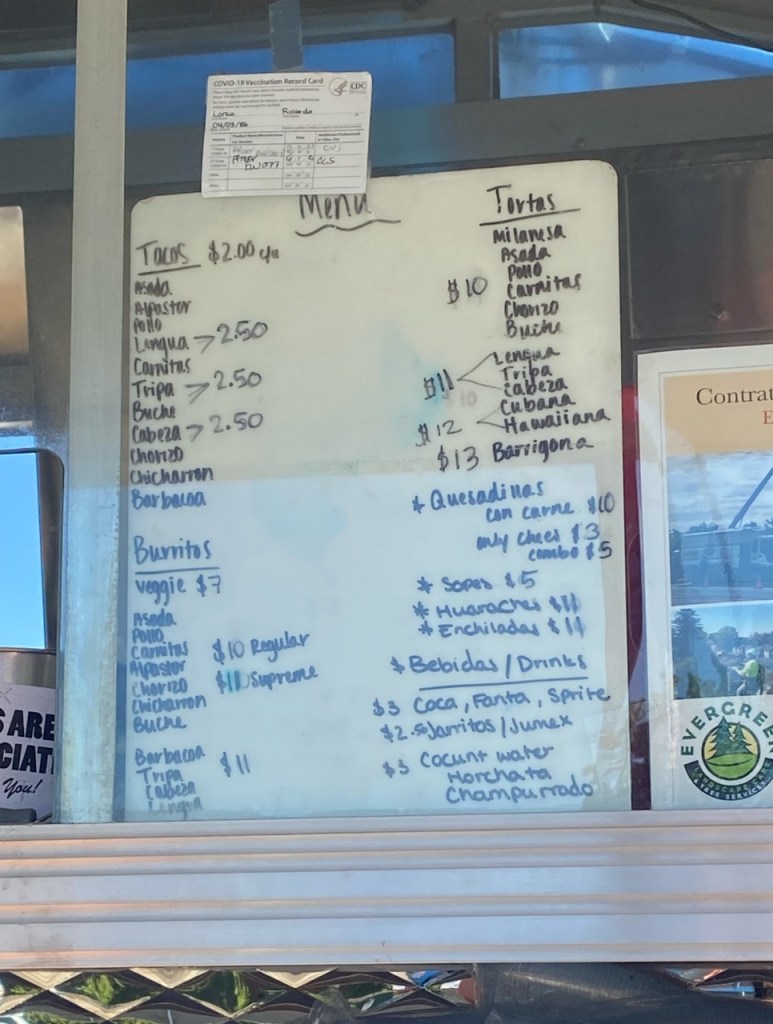
It just so happens that lengua is the favorite of my lovely dining partner this evening, my girlfriend Arianna. When it comes to food, she can be a bit of perfectionist, with the mind of a food critic and the palate of a chef. So when she describes the offerings at La Morenita Ricos Tacos as “the best I’ve had outside of California, you know they’re legit. She ordered 3 carnitas (pulled pork) and 3 lengua tacos, along with a big cup of iced horchata (a sweet, cinnamon-y beverage made from rice)


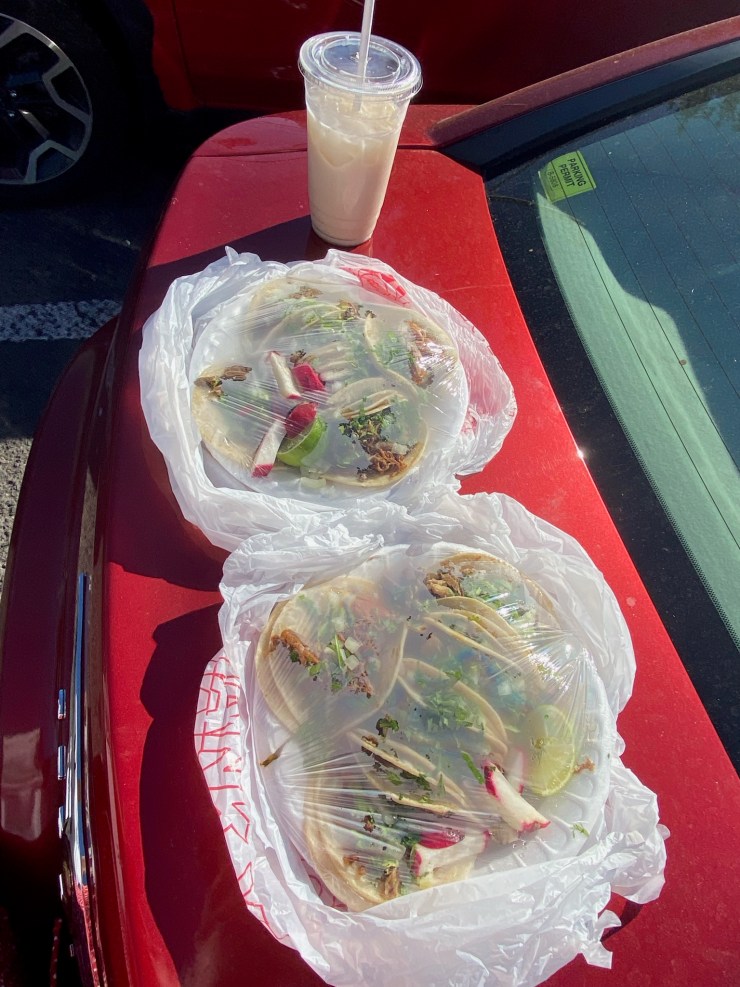
Meanwhile, I ordered some tacos of my own: 2 carnitas, 1 lengua, 1 al pastor (roasted pork w/ pineapple), and 1 barbacoa (slow-cooked barbecue). For those who don’t know about the glory of al pastor, allow me to take you on a brief historical journey that starts with the Ottoman Empire.

Though the Ottoman Empire was tolerant of other religions by imperial standards, non-Muslims were still treated like second-class citizens. Such was the case of the Maronites, a Lebanese Catholic minority. During the latter years of World War I, the Allies had blockaded the Eastern Mediterranean and there was a shortage of grain. As a result, the Ottoman administration barred crops from entering the area populated by the Maronites and redirected those crops to the military. This combined with crop failure at the hands of locusts (do they have hands?) led to mass famine, known today as the Great Famine of Mount Lebanon. Half of the population of Mount Lebanon starved to death, and many of the survivors fled to other countries, including Mexico. The fleeing Maronites hoped to find acceptance in the Catholic-majority Mexico, and they did. But more importantly (at least for our story) the Maronites brought many aspects of their culture to Mexico, including a particular way of cooking meat – upright on a rotating spit, known as shawarma. They adapted their cuisine to include local ingredients such as pork (which they ate, being Christian, not Muslim), spices, chilies, pineapple and more. And thus, al pastor was born, the bastard child of Lebanese and Mexican cuisines.
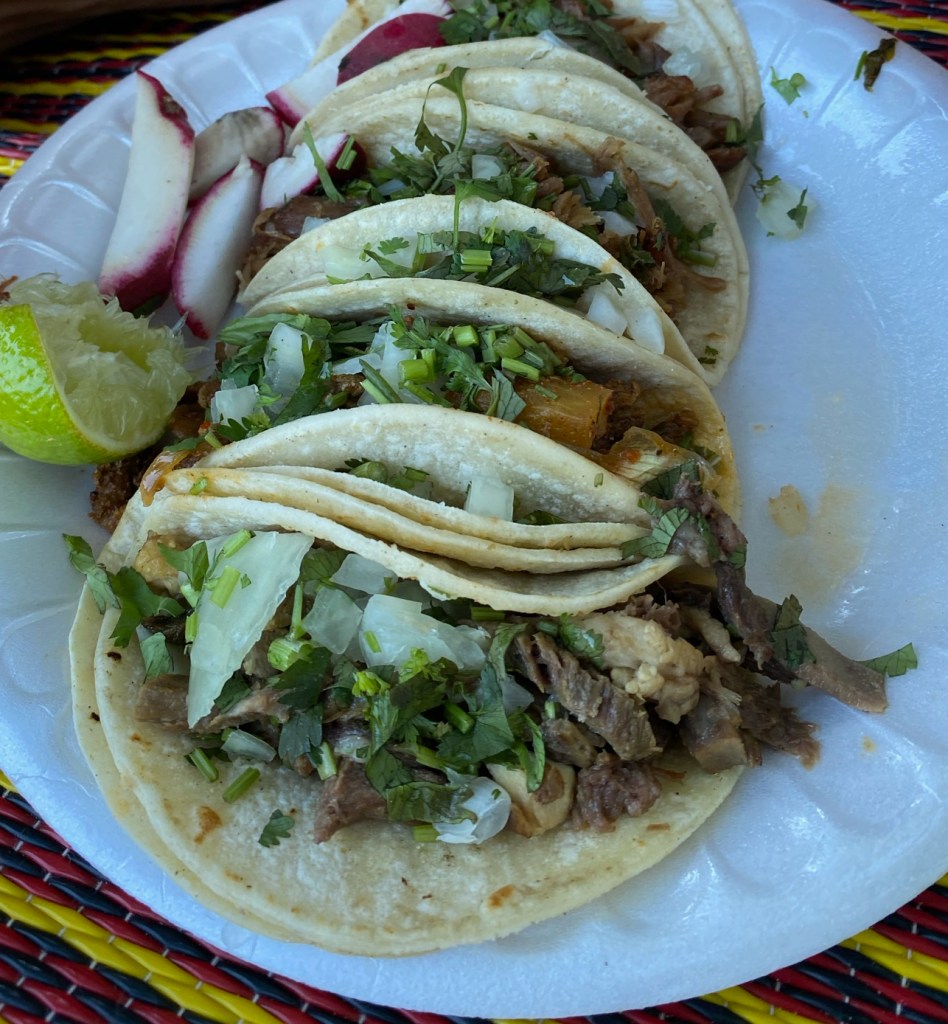
Anyways, back to the present. Check out our taco lineup.
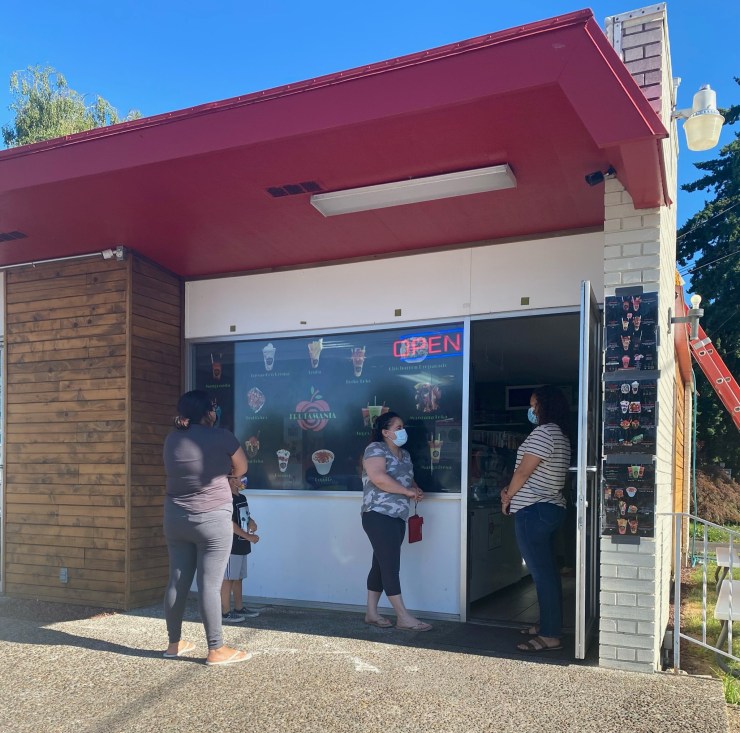
It was time for one more stop before we could descend on our feast like a pack of wild dogs. A quick walk across the street landed us at Fruitmania, a tiny shop dishing out fast-food style Mexicans snacks, beverages, and desserts.
I ordered a mangonada, which I don’t really know how to describe. It’s basically mango sorbet blended with chamoy (a savory, sour sauce made from pickled fruit, not unlike a Japanese umeboshi). It’s poured into a cup, garnished with Tajin (a seasoning made from ground chili, lime, and salt) and tamarind candy. The whole affair is sweet, sour, savory, and incredibly refreshing.

We had arrived at a nearby park, where it was finally time to dig into our feast.

These tacos were simply incredible. They changed my entire perception of tacos as a dish. Each morsel of meat was bursting with flavor and brimming with umami, not unlike the way that a good barbecue is. After all, what’s really the difference between carnitas and a good Memphis style pulled pork? A handful of spices? That’s pretty much it. Both are examples of perfection in simplicity, neither needs any sort of sauce to add flavor. In the case of our tacos, all they need is some crunch and acidity (lime, onions, and cilantro) and a way to travel from the plate to our mouth (a beautiful homemade tortilla).
So what have we learned today? We learned that there is incredible Mexican cuisine in Beaverton, OR. We also learned that, however indirectly, the policies of the Ottoman Empire caused the birth of a delicious type of taco. And to me, someone interested in both food and world history, that’s pretty damn fascinating. It’s a real ripple effect moment. Or for our more cultured audience members, a real AP Human Geography moment (thanks Chenne).


That’s gonna do it for today, folks. For my Oregon peeps, make the trip out to La Morenita Ricos Tacos and Fruitmania ASAP. You won’t regret it. Trust me.


 Eat It
Leave a reply to kellyw100 Cancel reply