*originally published on November 30, 2016 on ripcityramblers.wordpress.com*
We are two and a half months into Journey™, and now is the time to look back at my favorite foods from our travels thus far. Though it wasn’t easy, I ranked my ten favorites, which meant narrowing down every single thing I have eaten since September 12th. As soon as this is published worldwide, I will begin anew, and when the time is right another “ZEV’S TOP 10” post will come your way, with entirely new foodstuffs.
But for now, bone app the teeth and itadakimasu. Please fasten your seat belts, make sure your tray tables are closed and seat backs are in the upright position because I am going to learn you whippersnappers a thing, or 10.
And now, put your digital hands together for…
10. FOSCO

PLACE OF ORIGIN: Depot Hok Lay Restaurant, Malang, Java, Indonesia
KEY INGREDIENTS: Chocolate, cow milk, mystery ingredients
DETAILS: Fosco is a chocolate, malty drink I had at a restaurant near our hotel in Malang. This restaurant, named Depot Hok Lay, has been around since 1946. They invented this drink, which they bottle in old Coca Cola bottles, and named it Fosco. The most accurate description of taste would be Whopper malt balls blended up with milk. I mean, it tastes like something you’d have for breakfast on the day after Halloween.
9. FRIED BANANAS

PLACE OF ORIGIN: Thailand
KEY INGREDIENTS: Bananas (duh), a rice flour based batter that has a vanilla-y flavor, oil
DETAILS: Fried bananas are popular all over Southeast Asia, but I’m listing them under Thailand because that’s where I first had them. They are a popular street food and we had them a lot! They’re especially delish with chocolate sauce on top. But be careful, they are often fresh out of the deep-fryer and very hot!
8. GADO-GADO


PLACE OF ORIGIN: Indonesia
KEY INGREDIENTS: veggies, peanut sauce, rice cake, hard-boiled egg
DETAILS: Gado-Gado is an Indonesian salad-like dish, consisting of boiled vegetables (mostly cabbage, bean sprouts, some greens maybe), tempe, sometimes tofu, hard-boiled eggs, and a thick peanut sauce. The sauce is similar to what you might get as a dipping sauce for your sate. Perfect for cooling off on a hot day!
7. PAPAYA SALAD


PLACE OF ORIGIN: Thailand
KEY INGREDIENTS: Unripe shredded papaya, lime juice, fish sauce, garlic, salt, peanuts, chilies, sugar and dried shrimp
DETAILS: Papaya salad is actually from Lao, but because I had it in Thailand I’m listing it under Thailand. Papaya salad is not sweet, despite the fact that papaya is a fruit. Unripe papaya is shredded, drowned in the above-listed ingredients, and served cold. It is loaded with Umami and one of the few salads I willingly shovel in. (Sometimes it is so spicy, I give it to Doug to finish because it gets so intense.)
6. KUE PUKIS


PLACE OF ORIGIN: Indonesia (though Kue is also popular in the Netherlands due to colonial ties.)
KEY INGREDIENTS: Flour and coconut milk-based batter, chocolate or banana, et cetera
DETAILS: Kue is a little cake thing, rather like an artisan Twinkie. It smells amazing, and tastes even better. It’s so warm, so soft! Total comfort food. We had chocolate and vanilla ones, banana ones, and ones with chocolate sprinkles (which Doug, being an East Coast native, prefers to call “jimmies”). The batter is poured and then cooked in special Kue molds giving the Kue its unique shape and taste. YUM!
5. MU PING WITH STICKY RICE

PLACE OF ORIGIN: Thailand
KEY INGREDIENTS: Pork shoulder, sticky rice
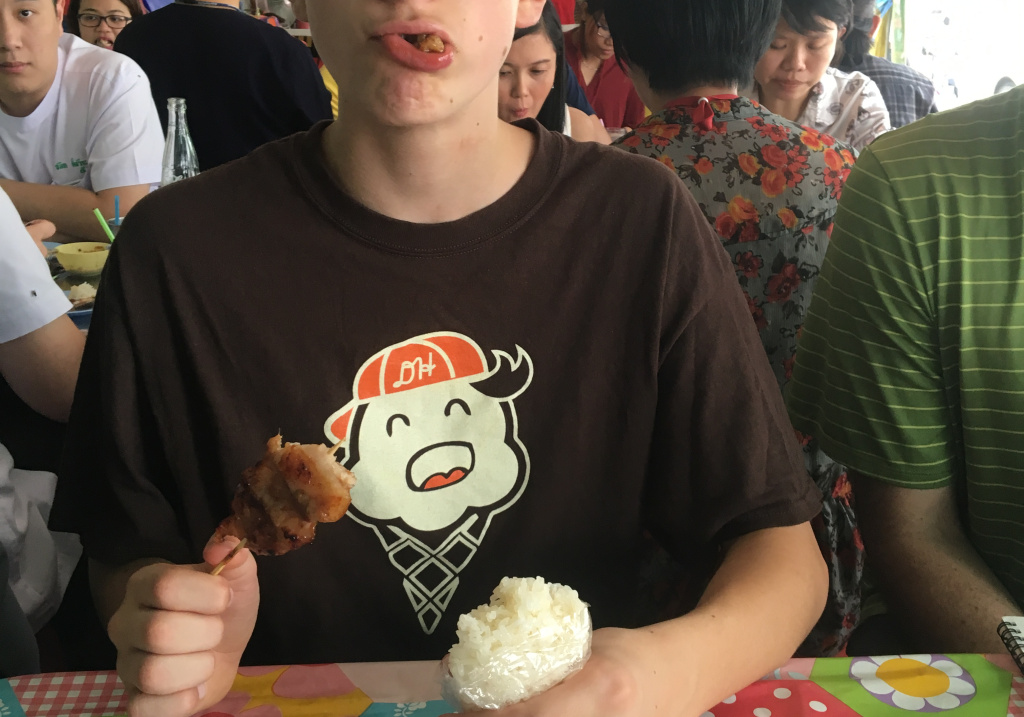
DETAILS: Mu Ping is pork marinated with cilantro, garlic and many other herbs and spices. Grilled over wood charcoal and served on a stick. You take a bite of meat, then a bite of sticky rice. It’s insanely good, and insanely cheap. It was just 10 baht ($0.28) for the skewer, and 5 baht ($0.14) for the rice on a street corner near our Bangkok apartment. It was breakfast every morning there, and often a snack later in the day.
4. DIM SUM

PLACE OF ORIGIN: China
KEY INGREDIENTS: Meat, seafood, wonton wrappers… the list goes on forever!
DETAILS: Yes, I know. Dim Sum is Chinese, why is it on the list? I had this particular meal in Georgetown, Penang, Malaysia. Roughly 25% of the population there is Chinese. This means good Dim Sum in Georgetown’s Chinatown. My favorite here was the cilantro ha gow (ha gow is shrimp dumpling). Dim Sum has so much variety, how can anyone not like it?
3. KETOPRAK

PLACE OF ORIGIN: West Java, Indonesia
KEY INGREDIENTS: Rice vermicelli noodles, vegetables, peanut sauce, sometimes tofu or tempe, rice cake
DETAILS: Ketoprak can mean two things: One is this tasty dish, the other is a traditional theatrical performance. Kinda confusing. Even though we haven’t been to West Java yet, this still made the list because I had it twice at a Javanese restaurant on Bali. It’s very similar to Gado-Gado (mentioned previously), but ketoprak has rice noodles as the focus, not veggies. A nice, cheap, filling meal.
2. WANTAN MEE


PLACE OF ORIGIN: China (Malaysia helped)
KEY INGREDIENTS: Noodles, pork, wontons
DETAILS: Wantan mee is wonton noodle and there are so many varieties, but the kind I’m talking about is fried noodles soaking in a delicious sauce with pieces of barbecued pork on top. As with Dim Sum, we have not been to China, but I had some of the best Chinese food of my life in Georgetown, Penang, Malaysia. We literally had wantan mee at least once a day when we were there.
There are many wantan mee places in Georgetown, but the best and most famous place is a little stall on Chulia street. You can also get wantan mee “wet” in a pork or chicken based broth instead of “dry” in the oily brown sauce. Maya prefers it that way. The rest of us, both are amazing, but if it came down to it, we’d go sauce over broth.
1. SAMOSAS


PLACE OF ORIGIN: India
KEY INGREDIENTS: Hard boiled egg, flour, ginger, coriander, garam masala, and many more
DETAILS: Here it is, my favorite food on Journey thus far, out of roughly 236 meals and countless snacks, desserts, and drinks: SAMOSAS!
Some of you might be asking yourselves, “What in the name of Sam Hill is a samosa?” A samosa, or a curry puff, is a popular deep-fried snack of Indian origin. They’re made out of dough, and stuffed with a savory spicy filling.
Roughly 8% of Penang’s population is Indian, so it’s no surprise that there is a Little India. In said Little India, there is a host of good food, including samosas. The samosas that we enjoyed came in three types: Chicken, egg and fish. The egg ones were my fave, they contained chunks of hard-boiled egg and other goodies. (For more on samosas, see Georgetown brings it!)
And that’s a wrap – stay tuned for another episode of “Zev’s Top 10” coming sometime in the not too distant future.


 Eat It
Leave a reply to Zev’s Top 10: Saigon – Eat It Cancel reply